Leveraging Snowflake and Snowpark for Seamless API Data Ingestion

April 1, 2026

Fabric

8 min read

Leveraging Snowflake and Snowpark for Seamless API Data Ingestion

Introduction

In today’s data-driven world, businesses increasingly rely on external APIs to enrich their analytical insights. From financial market data to social media feeds and IoT sensor data, APIs are a treasure trove of information. However, ingesting diverse and dynamic data into a data warehouse efficiently and reliably can be challenging.

Traditionally, integrating API data into a data warehouse like Snowflake often involves building complex ETL (Extract, Transform, Load) pipelines outside the platform. This usually meant managing external compute resources, handling data transformations in separate scripts, and dealing with the overhead of data movement. This approach could lead to increased operational complexity, higher costs, and potential data latency.

Enter Snowflake and Snowpark. This powerful combination offers a paradigm shift, allowing organizations to bring computation to the data, rather than the other way around. With Snowpark, developers can leverage familiar programming languages like Python to build robust data pipelines directly within Snowflake, streamlining API data ingestion like never before.


The Challenges of API Data Ingestion

Before diving into the solution, let’s briefly review the common hurdles faced when integrating API data:

  • Diverse API Structures: APIs come in various formats (REST, SOAP, GraphQL) and often return data in nested JSON, XML, or other complex structures, requiring intricate parsing and flattening.
  • Authentication and Authorization: Securely managing API keys, tokens, and OAuth flows can be tedious and time-taking.
  • Rate Limiting and Paginating: APIs may impose restrictions on the number of requests per unit of time, necessitating careful handling of rate limits and pagination to retrieve complete datasets.
  • Error Handling and Retries: Network issues, API downtime, or malformed responses require robust error handling and retry mechanisms to ensure data integrity.
  • Scalability: As both the volume of data and how frequently it’s collected increase, the pipeline must scale efficiently to avoid performance or cost issues.
  • Data Transformation: Raw API data often needs significant transformation, cleansing, and enrichment before it’s ready for analysis.

Why Snowflake and Snowpark Are a Game-Changer

Snowflake, as a cloud-native data platform, provides a highly scalable and efficient environment for data warehousing. Snowpark extends this power by allowing developers to write code in their preferred languages (Python, Java, Scala) and execute it directly within Snowflake’s virtual warehouses. This “code-to-data” approach offers several compelling advantages for API data ingestion:

1. In-Platform Processing: With Snowpark, you can write Python code to call APIs, parse responses, and transform data without moving the data out of Snowflake. This helps cut down on data egress costs and boosts performance by making the most of Snowflake’s elastic compute.

2. Simplified Architecture: Eliminate the need for external ETL tools or separate compute clusters for API integration. You can keep your entire data pipeline, from API call to final table, within Snowflake.

3. Scalability and Performance: Snowpark makes use of Snowflake’s underlying architecture, automatically scaling compute resources to handle varying API data volumes and processing needs.

4. Enhanced Security: Securely manage API credentials using Snowflake’s native Secrets Manager. Network rules can be defined to control outbound access to external API endpoints, ensuring a highly secure data flow.

5. Native Language Constructs: Leverage the rich ecosystem of Python libraries (e.g., requests, pandas, json) directly within Snowpark, making complex data manipulation and transformation much more intuitive than pure SQL.

6. Automated Orchestration: Snowflake Tasks can be used to schedule and orchestrate Snowpark-based API ingestion processes, ensuring timely and automated data updates.

Moving the filter from the heading to the filter pane allows the title to update dynamically based on the selected service, making the chart easier to understand.

A Practical Approach to API Data Ingestion with Snowpark
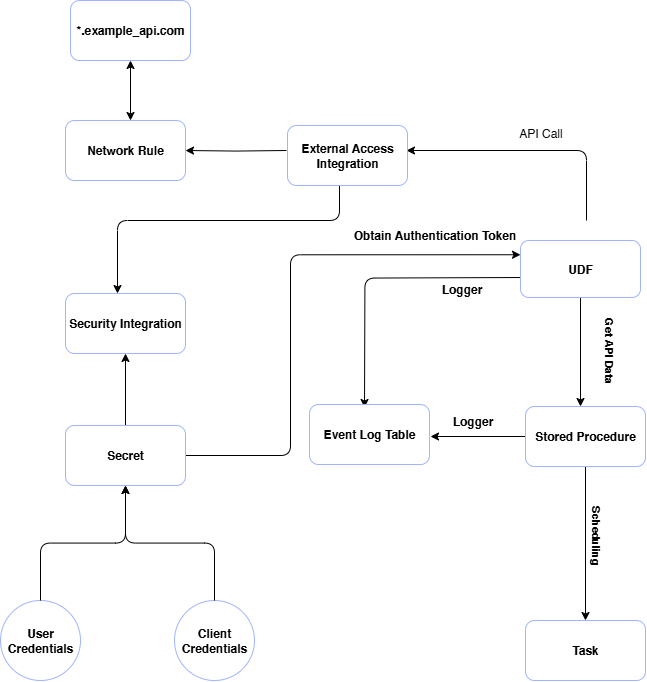
Here’s a high-level overview of how Snowpark can be leveraged for seamless API data ingestion:

1. Establish Connectivity and Security:

  • Network Rule: Define a Snowflake Network Rule to allow outbound connections from your Snowflake account to the specific API endpoint(s) that need to be consumed. This will act as a firewall, whitelisting approved external access.

Note: External network access from Snowflake is currently limited to supported regions and platforms. Depending on your account type, such as Business Critical edition or higher, certain capabilities like External Access Integration may be required. You will need to ensure your Snowflake edition supports outbound connections before designing your API ingestion flow.

  • External Access Integration: Create an External Access Integration in Snowflake, referencing your Network Rule. This integration will provide the authorization for your Snowpark code to reach external services.
  • Secrets Management: Use Snowflake’s Secrets Manager to securely store sensitive API keys, tokens, or other credentials. You will no longer need to hardcode credentials in your code. This approach also improves the overall security of the data pipelines.

2. Develop the Snowpark Python Code:

  •  Snowpark Session: Set up a Snowpark session, which will serve as your gateway to interacting with Snowflake from your Python code.
  • API Call and Response Handling: Use Python libraries like requests within your Snowpark code to make API calls. The requests library is ideal for handling HTTP requests, including authentication, headers, and various request types (GET, POST).
  • Data Parsing and Flattening: Process the API response, usually JSON, using Python’s json For nested JSON, you can flatten the structure into a tabular format suitable for Snowflake tables. Libraries like pandas (which integrates very well with Snowpark DataFrames) can be incredibly helpful here.
  • Error Handling and Logging: Implement robust error handling (e.g., try-except blocks) to manage API-specific errors, network issues, and rate limits. Log relevant information to a Snowflake event table for monitoring and debugging.
  • Snowpark DataFrame Creation: Convert your processed Python data into a Snowpark DataFrame. Snowpark DataFrames are lazy-evaluated, meaning operations are pushed down to Snowflake for execution, optimizing performance.
  • Data Ingestion to Snowflake Table: Use the
    mode(“overwrite”).save_as_table() or
    write.mode(“append”).save_as_table() methods
    of the Snowpark DataFrame to directly ingest the data into your target Snowflake table.

2. Orchestrate with Snowflake Tasks

  • Stored Procedure: Encapsulate your Snowpark Python code within a Snowflake Stored Procedure. This will enable scheduled execution and better error handling.
  • Snowflake Task: Create a Snowflake Task to schedule the execution of your Stored Procedure at intervals (e.g., hourly, daily, weekly). Tasks provide robust scheduling, retries, and dependency management.

Best Practices for Optimal API Data Ingestion

  • Incremental Loads: For large and frequently updated APIs, implement incremental loading strategies to fetch only new or changed data, minimizing processing time and costs.
  • Data Validation: Incorporate data validation checks within your Snowpark code to ensure the ingested data meets quality standards before it’s loaded into the final tables.
  • Schema Evolution: Be prepared for potential changes in API response schemas. Snowflake’s schema evolution capabilities and careful schema inference in Snowpark can help manage this.
  • Monitoring and Alerting: Leverage Snowflake’s monitoring tools (e.g., Query History, Account Usage views) and integrate with external alerting systems to track the health and performance of ingestion pipelines.
  • Modular Code: Break down complex ingestion logic into smaller, reusable Snowpark functions and procedures.
  • Parameterized Queries: Use parameters for API URLs, table names, and other dynamic values to make the ingestion process flexible and reusable.


Conclusion

Leveraging Snowflake and Snowpark for API data ingestion empowers data professionals to build highly efficient, scalable, and secure data pipelines directly within the data cloud. By embracing the “code-to-data” paradigm, organizations can significantly reduce complexity, optimize costs, and accelerate the time to insight from valuable external API sources. As the demand for real-time and diverse data continues to grow, Snowpark will undoubtedly play a pivotal role in shaping the future of data integration.

To explore how we can help your business streamline API data ingestion with Snowflake and Snowpark, click here.

Contact OnPoint Insights today and see how we can help your business operations reporting needs!
+1(978) 788 2563

For more insights, you can explore OnPoint Insights blog where we discuss various topics

Explore OnPoint Insights | Read More Blogs


References

Contact Us

Collaborate with us

We're here to answer your questions and help you find the right solution.

Client-oriented
Results-driven
Problem-solving
Transparent

"*" indicates required fields

This field is for validation purposes and should be left unchanged.